
In this article
There’s an old line in marketing: people don’t want a quarter-inch drill, they want a quarter-inch hole. It is usually credited to Theodore Levitt, who taught marketing at Harvard. The point behind it is more useful than the cliché suggests.
People don’t buy products and services. They hire them to make progress on something they’re trying to get done. Understand the job, and a lot of marketing decisions make themselves.
That is the jobs-to-be-done lens, a phrase most closely tied to Clayton Christensen, also of Harvard, and Competing Against Luck, the 2016 book he wrote with colleagues. You don’t need the book to use it. You need one question, answered from evidence rather than instinct.
What you are, and what they need done
Most organisations describe themselves by what they are. A marketing agency, a case management provider, a recruiter. Buyers think in terms of what they need done.
| What you call yourself | What the buyer needs done |
|---|---|
| A marketing agency | Make us the obvious choice to this committee |
| A case management provider | Get my injured client the right support |
| A recruiter | Fill this shift by Friday |
| A kitchen company | Give us a kitchen we will still love in ten years |
| A charity | Let me do something real about a cause I care about |
| A local council | Sort out my missed bin collection in two minutes |
When your marketing speaks to the job rather than the category, it lands, because it meets the buyer where their actual problem is. That holds whether your buyer is a procurement team, a family, a donor or someone using a public service. Only the jobs change.
The real job is rarely the obvious one
The question to sit with is this: when someone chooses us, what job are they hiring us to do?
Every job has three layers: the practical thing that has to get done, how the buyer wants to feel about it, and how they want to be seen. The brief records the first. The other two usually decide it.
| Layer | The question behind it | Someone hiring an agency for a rebrand |
|---|---|---|
| Practical | What has to get done? | A new identity and website, ready for the launch |
| Feeling | How do I want to feel? | Certain, and relieved of the risk of getting it wrong |
| Audience | How do I want to be seen? | As the person with the ammunition to win the argument inside the business |
Name the real job and your messaging stops being about your service and starts being about their progress.
People don’t buy what you are. They hire you to make progress on something. Market to the progress.
How to find the job
You won’t find it in a workshop with your own team. They know what you sell, not why people buy it. Only buyers know what they were trying to get done, so ask them what happened rather than what they think.
- 01Talk to recent buyers
People who chose you in the last few months, while the decision is fresh, and one or two who chose someone else.
- 02Start at the moment it began
Ask what was happening when they started looking. Something changed, and that usually points at the job.
- 03Ask what they used before
An old supplier, a spreadsheet, or nothing at all. That is what you are really replacing.
- 04Ask what nearly stopped them
The worry, the colleague’s objection, the risk to their own name. This is where the feeling and the audience show up.
- 05Write the job in their words
When this happens, I want to get this done, so that I can do this next. If you can’t write it from what people said, keep listening.
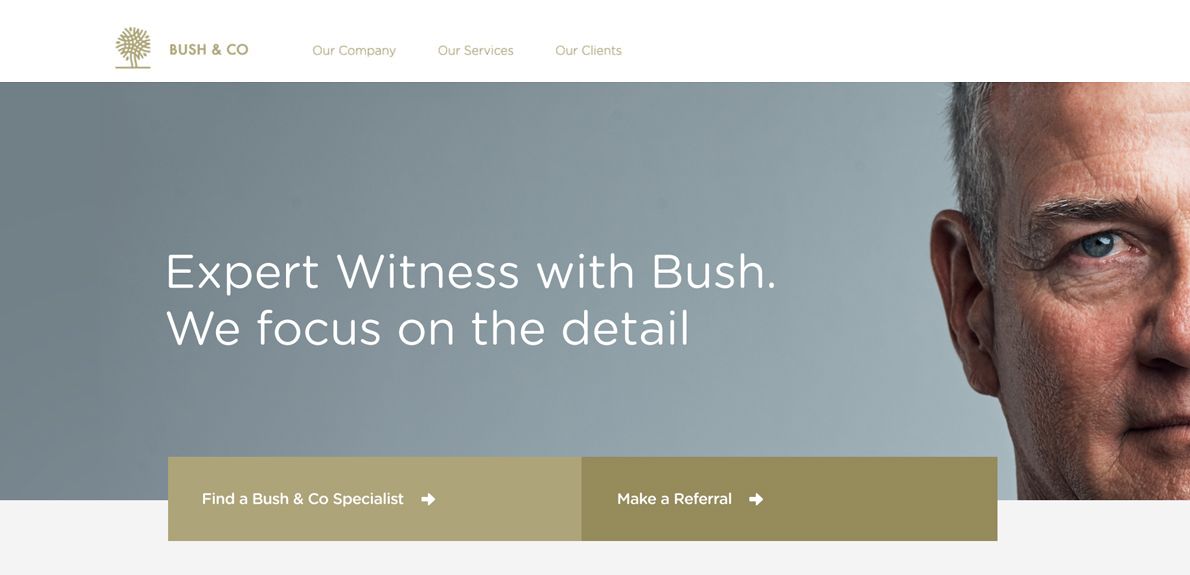
When we rebuilt the brand for Bush & Co, which provides case management and expert witness services for catastrophic injury, we interviewed the solicitors and insurers who choose them: how and why they used Bush, the pains and gains of the relationship, and what made them pick Bush over others.
Three themes kept coming back. Relationships were built on the quality and personality of the consultants. Solicitors searched for a consultant by geography first. And they were cautious by nature, and needed a push to try someone new.
Read through the lens, the job was never simply to buy case management. It was closer to: find the right expert, near my client, without putting my own judgement at risk. So we built a consultant finder on a visual map, filtering by specialism, geography and experience, where solicitors can shortlist, download CVs and save searches. We also reworked the consultants’ CVs to bring their experience and expertise to life.
That is human-centred design at its plainest. What good discovery actually looks like goes further into running those conversations.
One service, several jobs
The lens also sorts your audience usefully. Buyers who look identical on paper can be hiring you for different jobs: one for speed, one for certainty, one to look good internally. Those need different messages, even for the same service. Working out the handful of distinct jobs your buyers hire you for is often more useful than any demographic segmentation, because it tells you what to say.
Staffline, the largest provider of blue collar recruitment in the UK, serves two sets of people: clients who need roles filled, and candidates who need work. Candidates were getting harder to source, and they were struggling to find jobs through search engines, then struggling to apply.
So the brief put the candidate first, not the client. After a six week audit and workshops with clients and candidates, we built a mobile first job search and streamlined applying and registering. Do the candidate’s job well, and the client’s job gets easier too.

Anderson Group, a global outsourcing and payroll business, had an offering so varied it risked losing the contractors and recruiters it served, people with little time or interest in payroll. So the website mapped a route for each kind of visitor, by what they needed. Contractors, mostly on mobile, got accounts, timesheets and the legal stuff a tap away.
Sometimes the deciding part of the job is about someone else. The intermediaries who recommend and buy HCML’s corporate health services told us they rely on suppliers to validate what they recommend to their own clients, and they hunt for credible content to pass on, mostly on LinkedIn. Part of the job is helping them look right in front of their clients, so we built a year of content around it: a LinkedIn calendar, segmented emails, landing pages and lived experience stories.
They started with our customers rather than our logo, and the behavioural research they came back with told us things about how all our various customer groups choose a provider that we genuinely hadn’t seen before.
Where the lens goes wrong
Jobs invented in a meeting room are guesses in new vocabulary. A list of twenty jobs is as unhelpful as none, because it tells you nothing about what to say first. Keep to the handful that genuinely differ.
It doesn’t replace knowing who your buyers are and where to find them. It tells you what to say once you have their attention.
And it is not a licence to promise more. Naming someone’s real job raises the bar: the work has to deliver that progress, not just describe it.
Putting it to work
Once the jobs are named, they show up everywhere.
- Your homepage headline names the progress, not the category.
- Your case studies are chosen because they show the job done, not because the client is well known.
- Your sales deck opens with the buyer’s situation before it gets to yours.
- Your calls to action match the job. Someone who needs an expert this week needs a different first step from someone planning next year’s budget.
- Your copy uses the buyer’s words for the job, not yours.
Talking to the people who choose you is where our brand strategy work begins. If you’d like to talk through what your buyers are hiring you for, we’d be glad to hear from you.
Common questions
Is a job the same as a persona?
No, and the two work well together. A persona describes who someone is. A job describes what they are trying to get done, and why now. Two very different people can share a job, and one person can bring you different jobs on different days.
Can we do this ourselves?
Yes, and it is worth trying. The catch is that people speak more freely to someone who isn’t selling to them, and your own team tends to hear what it expects. An outside interviewer helps with both.