In this article
How much a website costs in the UK depends on a handful of decisions, far more than on the number of pages. How much thinking and content it needs, how bespoke the design is, what it has to connect to, and who looks after it afterwards are what move the price. Two sites that look alike can cost very different amounts.
As a rough guide, a small website with us is about £2,000 plus VAT, and carrying a new design across a small site you already have is £1,200 to £1,800. Bigger sites, and anything with custom features, are priced once we understand them. This guide shows what moves the figure, what people forget to budget for, and how to reach a sensible one, whether you run a business, a charity or a public body.
Three common shapes of website project
Most projects fall roughly into one of three shapes.
| Shape | What it usually includes | Where most of the money goes | What to watch |
|---|---|---|---|
| A brochure site | A handful of pages: who you are, what you offer, your proof and how to get in touch | The words, the pictures and getting the message right | A template that looks fine on day one but cannot grow with you |
| A content-led site | Services, sectors, case studies, articles, perhaps local pages | Structure, content, and the search work that helps people find it | A plan for who keeps the content coming after launch |
| A site with custom features | Finders, booking, members' areas, payments, data, or connections to other systems | Building, testing and maintaining the features | Features chosen from a wish list rather than from how people choose |
What affects the cost of a website?
Within any of those shapes, six things make most of the difference.
1. Strategy and content
A website that explains a complex offer clearly takes thinking before it takes design: who it is for, what they need to understand, and what you want them to do next. If that work is done well, everything after it is quicker. If it is skipped, the site often has to be redone.
That thinking is where research earns its place in the budget. Staffline, the largest provider of blue collar recruitment in the UK, was finding it hard to source enough candidates. We ran a six week audit of the brand, its data and its competitors, then workshops with clients and candidates, and the results gave a strong steer on what the site had to do.
The Ideate team worked with us on a full user experience journey, including meticulous research and planning on competitor and data analysis right through to detailed sketches, prototypes and behavioural design.
Content is the cost people underestimate most. Someone has to write the words, gather the case studies and source the photographs and film. If you have that ready, the project costs less. If the agency creates it, it is a real part of the budget, and usually money well spent. On Staffline we were asked to create the launch content too: copywriting, photography and film.
2. Design
A site built on a ready-made theme with light changes costs less than one designed around your brand from scratch. The question is not which is better in general, but what the people you need to reach have to see.
For many organisations, a design system the team can use to make new pages without breaking the layout is worth more than a handful of beautiful one-off pages. If every new page needs a designer, every new page is a bill.
3. Size and structure
More page types means more design and build time. Ten pages that share one layout cost less than ten pages that each need their own. A content-led site needs more planning than a brochure website of five or six pages.
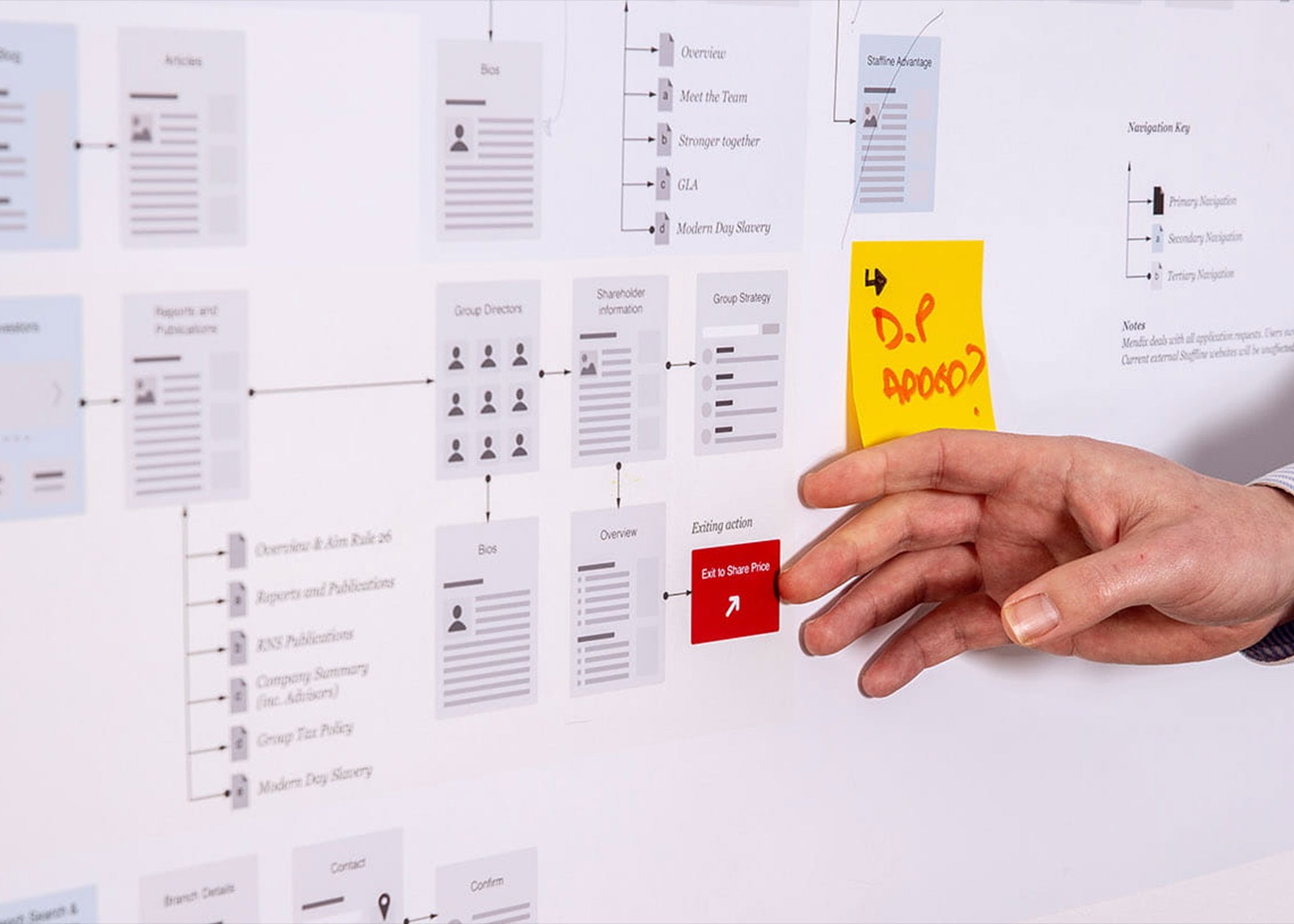
The cheapest moment to change the structure is before the design starts, while it is still a site map on a wall: quick to argue over and quick to redraw. The same change after the build is neither.
4. Features and integrations
Every feature that does something, rather than just shows something, adds cost: a form that feeds a CRM, booking, payments, a connection to another system. Each one needs building, testing and looking after.
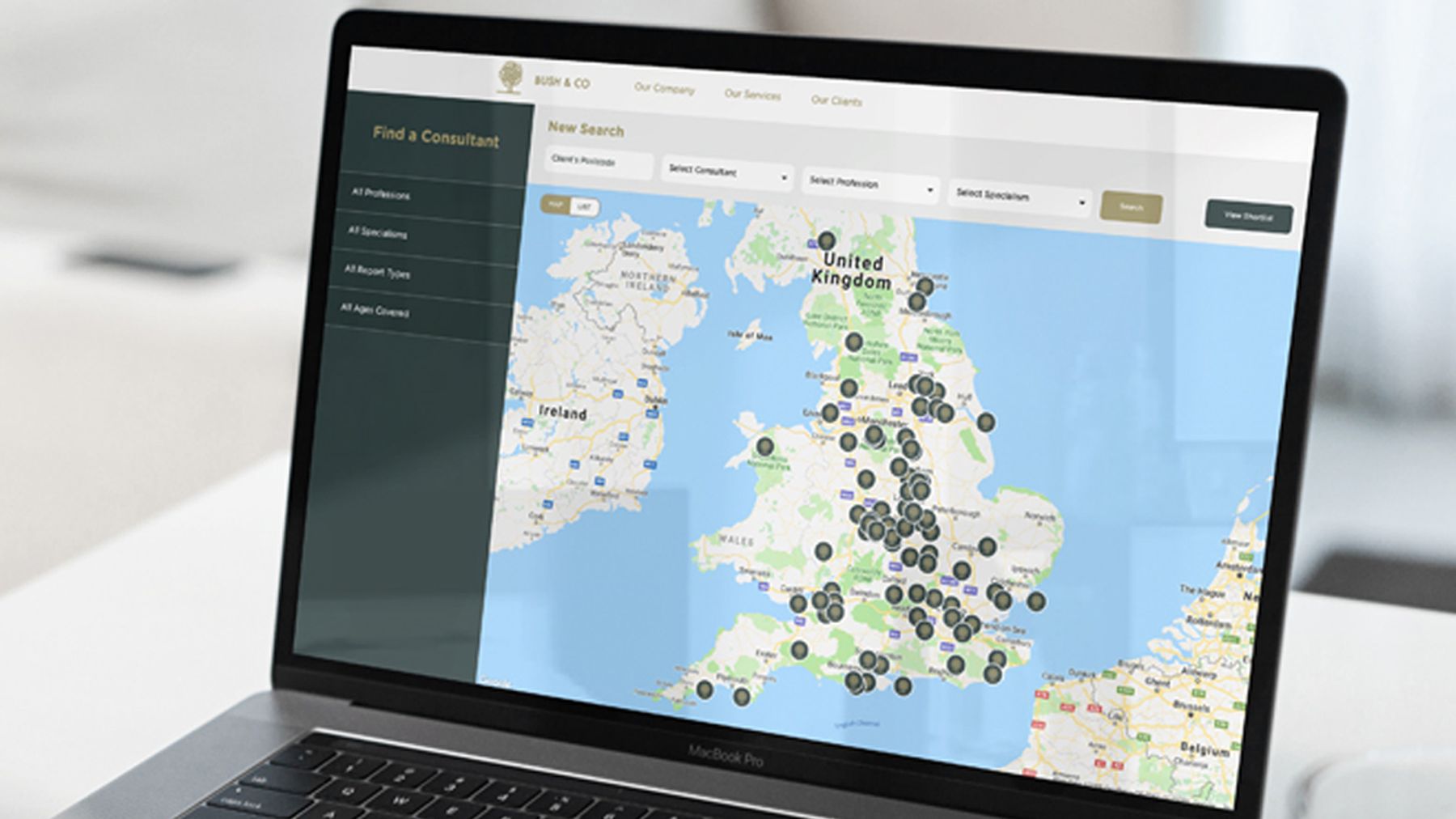
The way to keep that spend honest is to tie each feature to how people actually choose. When we interviewed the solicitors and insurers who choose Bush & Co, solicitors told us they searched for a consultant by geography first. So we built a consultant finder on a map, filtering by specialism, geography and experience, where solicitors can shortlist and download CVs.
5. Platform
Many sites are built on a content management system such as WordPress, so the team can edit pages without a developer. Others use a hosted website builder, or are built bespoke. Each has different costs up front and over time. Ask what you will be able to change yourself, and what a change will cost when you cannot.
6. Who builds it
The same brief is priced differently depending on who takes it on. Most of the difference is how much of the thinking you hand over.
- You, on a website builder. A monthly plan and your own time. The thinking, the writing and the building are all yours.
- A freelancer. One person builds to your brief, so the clearer the brief, the better the result.
- An agency. Strategy, content, design and build from one team, which helps when your offer takes some explaining.
Whoever you choose, ask who will actually do the work. At Ideate Partners you work directly with the people shaping the strategy and creating the work, as how we work explains.
What does a website redesign cost compared with a new site?
A redesign is not automatically cheaper than a new site. It starts with more to learn from: visitor data, the searches that already bring people in, and the enquiries the old site produced. It also has something a new site does not: something to lose.
If the current site earns visitors from search, every page that brings them must stay at its address or pass people on to the right new page, and someone has to check it worked. That work is easy to leave out of a quote and expensive to discover after launch. Our website redesign and SEO pages say more about keeping what already works.
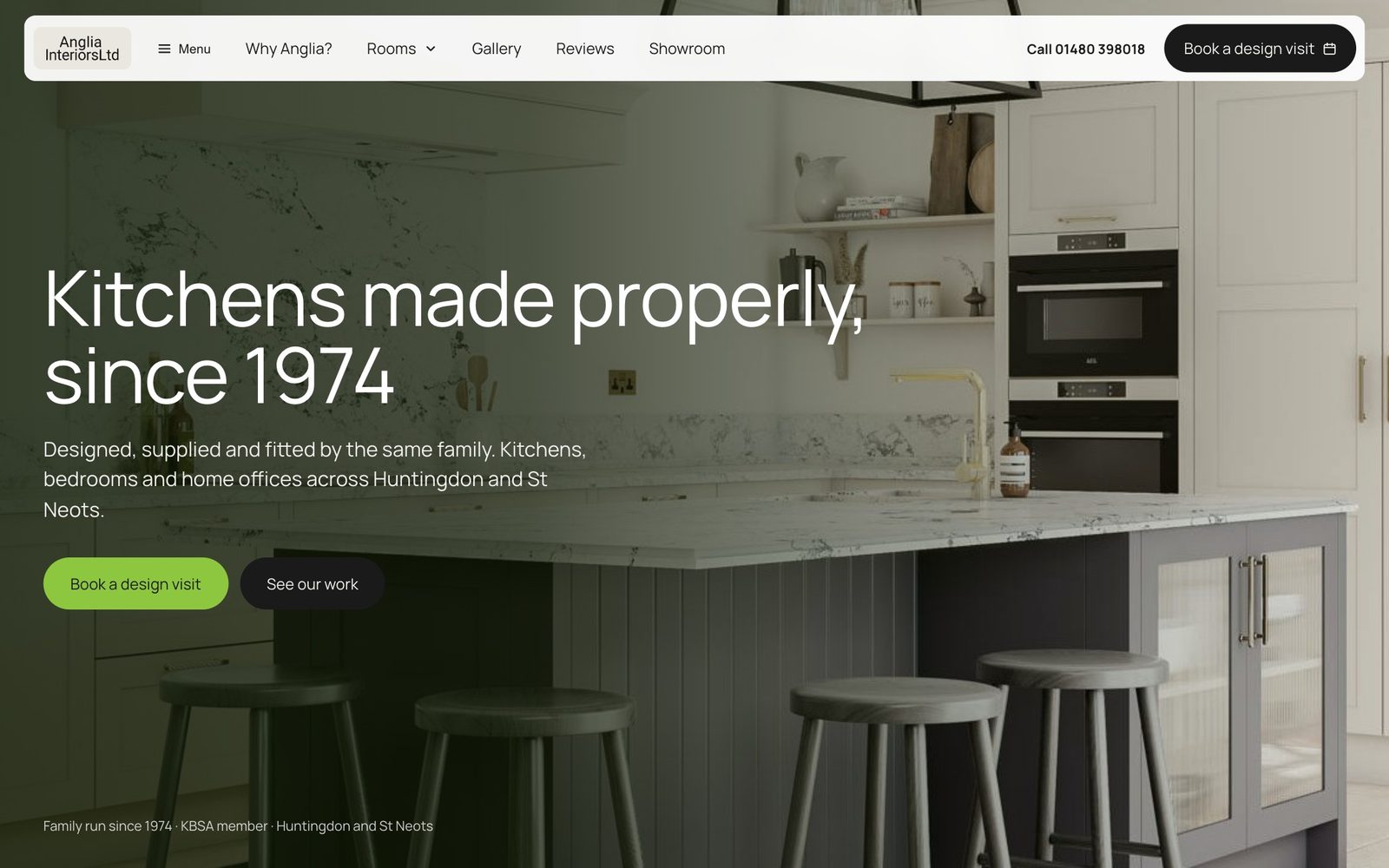
When we designed and built a new website for Anglia Interiors, a family-run kitchen, bedroom and home office business in Huntingdon, nothing it had earned in search was allowed to slip.
- 57Articles carried across word for word, each at the address it already hadAnglia Interiors launch-day check, 30 September 2026
- 106Addresses from the old site checked, every one answeredAnglia Interiors launch-day check, 30 September 2026
What are the ongoing costs of a website?
Launch is not the last bill. Budget for:
- Hosting. Where the site lives, usually including the security certificate that makes its address start with https. Ours is £30 to £50 a month, on a green UK server.
- Domain name. Renewed every year, or every few years.
- Licences. Some themes, plugins and website builders charge every year, not once.
- Maintenance and security. Updates to the platform and plugins, backups, and someone to call if something breaks. Ours starts at £20 to £30 a month for monthly checks, the fixes they find and small changes, with a short report. More is on our website care page.
- Content. New pages, articles and case studies, if the site is to keep earning its place in search.
- Improvements. A small monthly budget for testing and improving often does more than a large redesign every few years.
Measuring whether it works need not add to the bill. Google's Search Console and Analytics are both free, and between them they show what people search for to find you, which pages they read and where they leave.
Why do website quotes vary so much?
Because agencies are often quoting for different things. One quote might include research, copywriting, a bespoke design and training; another might be a theme with your logo dropped in. Both can be honest.
When you compare quotes, ask each agency:
- What research or strategy is included?
- Who writes the content, and who supplies the pictures?
- Is the design bespoke or a theme, and can our team add pages without breaking it?
- Will the site, the domain and the content be ours, so we could take them elsewhere?
- If we are replacing a site, how will you keep what it has earned in search?
- What happens after launch, and what does it cost?
- How will we know the site is working?
The answers tell you more than the totals.
How should you set a website budget?
Work from the job the website has to do, not from a figure you have heard.
- 01Decide what the site must achieve
More enquiries, better-fit enquiries, support for sales conversations, more bookings or donations, or a way into a new market.
- 02List what it needs, and what you already have
The pages, content, features and connections it needs, and the words and pictures you can supply yourself.
- 03Include the first year of running costs
Hosting, maintenance and some budget for improving what you learn is not working.
- 04Ask two or three agencies to quote against the same brief
That way you are comparing like with like.
If your offer is hard to explain, it is worth settling the brand strategy before you write the website brief.
Where to start
Write a one-page brief: who the site is for, what it needs them to do, what you already have, and when you need it. That page will get you better quotes than any number of meetings.
If you are not sure what your current site needs, our free marketing audit comes back with three things you could fix this month. No pitch, no tie-in. Or get in touch for an honest view of your project.
Common questions
How long does it take to build a website?
What moves it most is how ready the content is, how quickly decisions are signed off and how many features need building and testing. A redesign also needs time to check every old address still works.
Can I build a website for free?
Yes, on a website builder's free plan, though that usually puts the builder's name in your web address and its branding on your pages. Using your own domain name generally means paying. The bigger cost is your time, and the risk is a site that does not explain what you do as well as it could.
Is it worth paying more for a website?
A small website with us is about £2,000 plus VAT, and paying more is worth it only if the extra goes where the problem is. If people do not understand your offer, put it into strategy and content. If the site is slow or hard to update, put it into the build. Either problem left alone often costs more later, in lost enquiries and an early rebuild.
Can ChatGPT build a website?
AI tools can now draft page layouts, code and words quickly. What they cannot supply is what makes a site work: knowing who your customers are, how they choose and what will convince them. We use AI-supported research to explore markets and opportunities faster, but the judgement stays human, as how we use AI explains.
Should I redesign or improve my existing website?
If the structure and platform are sound, improving the content and key pages is often better value than starting again. If the site cannot be updated, is slow, or no longer reflects what you do, a redesign may be the better investment.